
Whether you’ve just purchased a farm or a bach and discovered that your water supply relies on a piston pump, encountering a broken pump can be frustrating—especially if you lack documentation and the pump has minimal markings. Let’s work together to identify what you have!
Option 1: If possible, please take a photo of your pump and email it to us at pumps@trackind.co.nz. This will help us assist you more effectively.
Option 2: If a photo isn't an option, let's break it down step-by-step:
Start by determining the size of your pump. Pumps generally fall into three categories:
The bore size is crucial for identifying your pump. This measurement refers to the water end (head) of the pump, where the plunger cup (made of leather or synthetic material) and piston assembly operate. To find this, you’ll need to remove the end cover and measure the internal diameter of the liner where the plunger cup moves.
| Bore Size (mm) | Bore Size (inch) | Pumps with this bore size |
| 25mm | 1" | Renown 150 |
| 32mm | 11/4" | Renown 200, B1-HP, MacEwans H0-HP |
| 35mm | 13/8" | Anderson 253 |
| 38mm | 11/2" | Renown 400, B1-STD, MacEwans H0-STD |
| 44mm | 13/4" | Renown 931, Anderson 402, B1-LP |
| 51mm | 2" | C1-HP, PowerFlo AHR |
| 57mm | 21/4" | MacEwans H1-HP |
| 60mm | 23/8" | Anderson 355-357 |
| 64mm | 21/2" | Renown 912 |
| 67mm | 23/4" | Anderson 605-607, C1-STD, MacEwans H1-STD, PowerFlo |
| 76mm | 3" | Renown 905, PowerFlo B, MacEwans H2-HP |
| 83mm | 31/4" | PowerFlo C |
| 89mm | 31/2" | Anderson 1105-1107, MacEwans H2-STD |
Different brands have unique designs, which can help in identifying your pump. Let's break it down by brand.
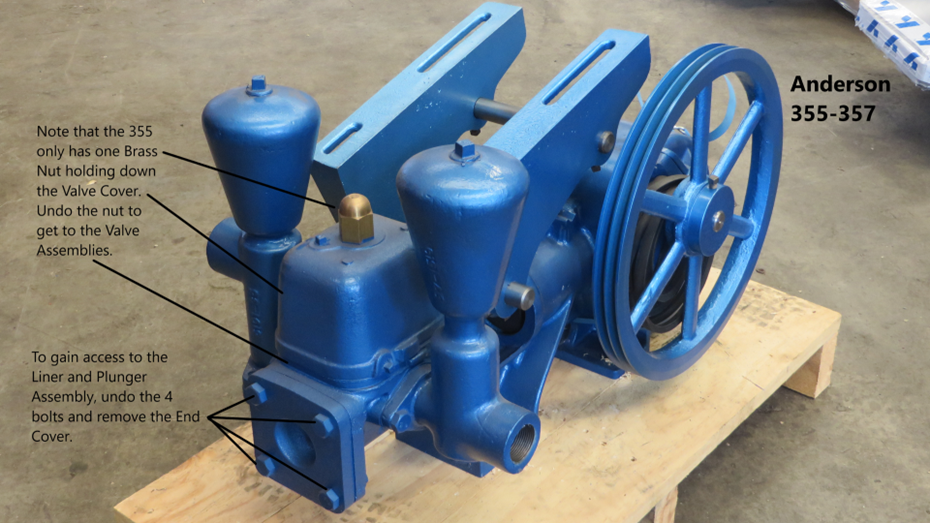
One of the defining characteristics of Anderson pumps is their Water-End (Head) construction, which consists of three main components:
These components are secured together with studs and large brass valve nuts. The number of brass nuts can be instrumental in identifying specific pump models:
The MacEwans range stands out with its distinct design, differing from other pumps on the market.
Models H1, H2, and H3 feature a three-part construction that is securely bolted together:
Two long bolts run down each side, ensuring the head components are tightly secured.
Model H0
The H0 head features a simpler structure, consisting of a main cylinder that contains the liner. An air chamber is vertically mounted and secured, with top valve assemblies bolted to the top of the cylinder for optimal functionality.
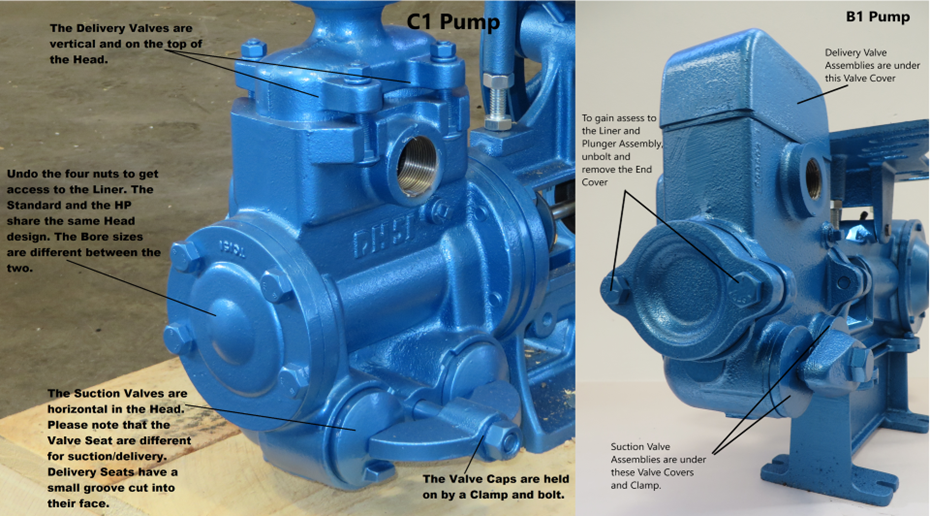
B1 (300) Pump
The compact B1 (300) weighs approximately 36 kg and measures 600 mm in length. Its valve assemblies are stacked on the head. The delivery side is positioned at the top of the pump, with the valve assemblies sitting vertically on the head. The suction side is located at the bottom of the pump, below the liner and plunger assembly, with the valve assemblies arranged horizontally.
C1 (500) Pump
The larger C1 (500) weighs around 90 kg and is 900 mm long. It follows the same valve configuration as the B1: delivery side on top, vertical in the head; suction side at the bottom, with valve assemblies positioned horizontally.
Valve and Cover Details
On both the B1 and C1, the suction valve caps are secured with a bolt and clamp, while the delivery valves are enclosed by an air chamber. The B1 uses a square-shaped cover, whereas the C1 features a bell-shaped cover.
Valve Seat Design
Please note that the valve seats differ between suction and delivery:
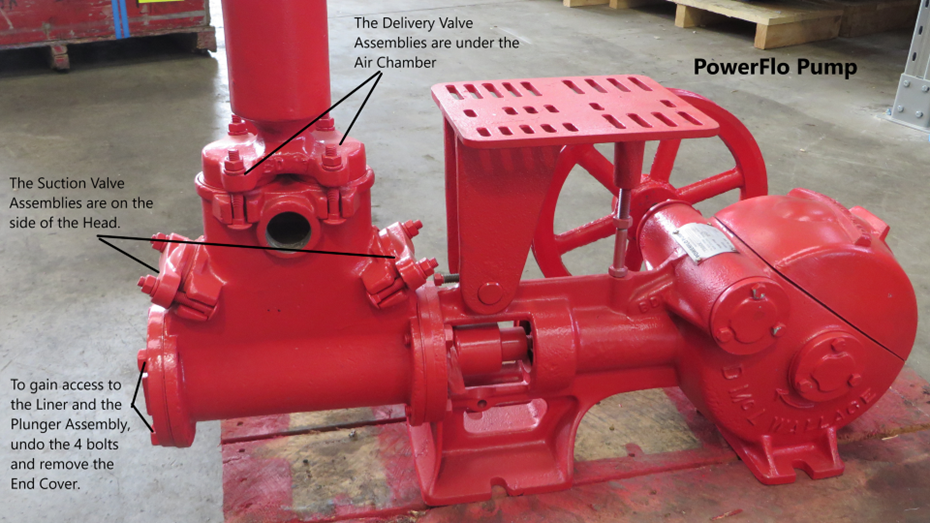
The PowerFlo series shares a common back-end and head design, closely resembling the Renown 900 series and some of the earlier Anderson pump designs.
These are medium-sized pumps, weighing approximately 90–100 kg.
PowerFlo Variants
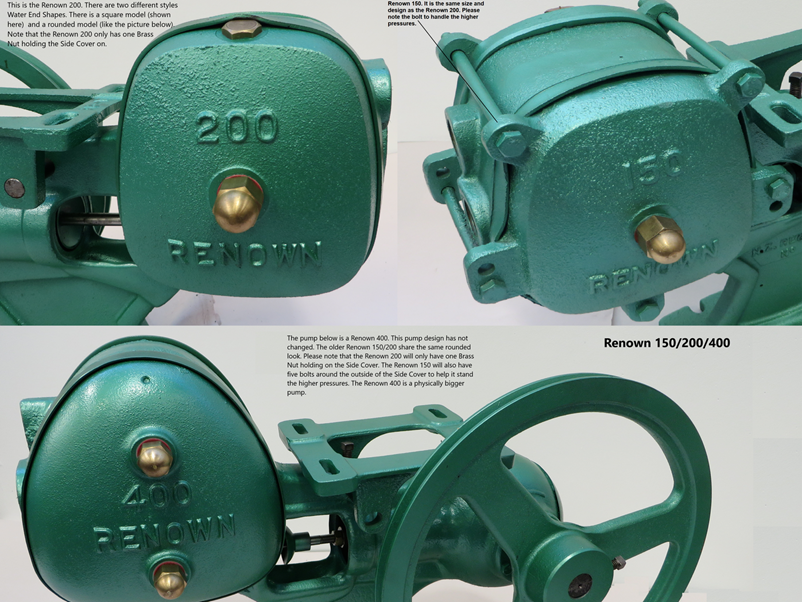
The Renown range includes a diverse selection of pumps. Below are the most common models: 150, 200, 400, and the 900 Series.
Renown 150 / 200 / 400
These models share a similar design where the Back-End and Water End are built into a single unit.
Head/Side Cover design notes:
Renown 900 Series
The 900 Series are larger, medium-sized pumps, weighing 90–100 kg. They share the same back-end design and parts, but differ in head and valve configurations.
Renown 912 / 905
Renown 931